
College Ruled vs. Wide Ruled Paper: Line Spacing Compared (7.1mm, 8.7mm, 6.35mm)
College Ruled, Wide Ruled, and Narrow Ruled paper use different, oddly specific line spacings. Compare the exact measurements in mm and inches and see which one fits your handwriting size or note-taking style.
Tip: When matching a specific brand of notebook, measure 10 line gaps with a ruler and divide by 10 rather than trusting the commonly quoted rounded millimeter figure, since even a small per-line rounding error adds up across a full page.
Standard line spacings: College, Wide, and Narrow Ruled
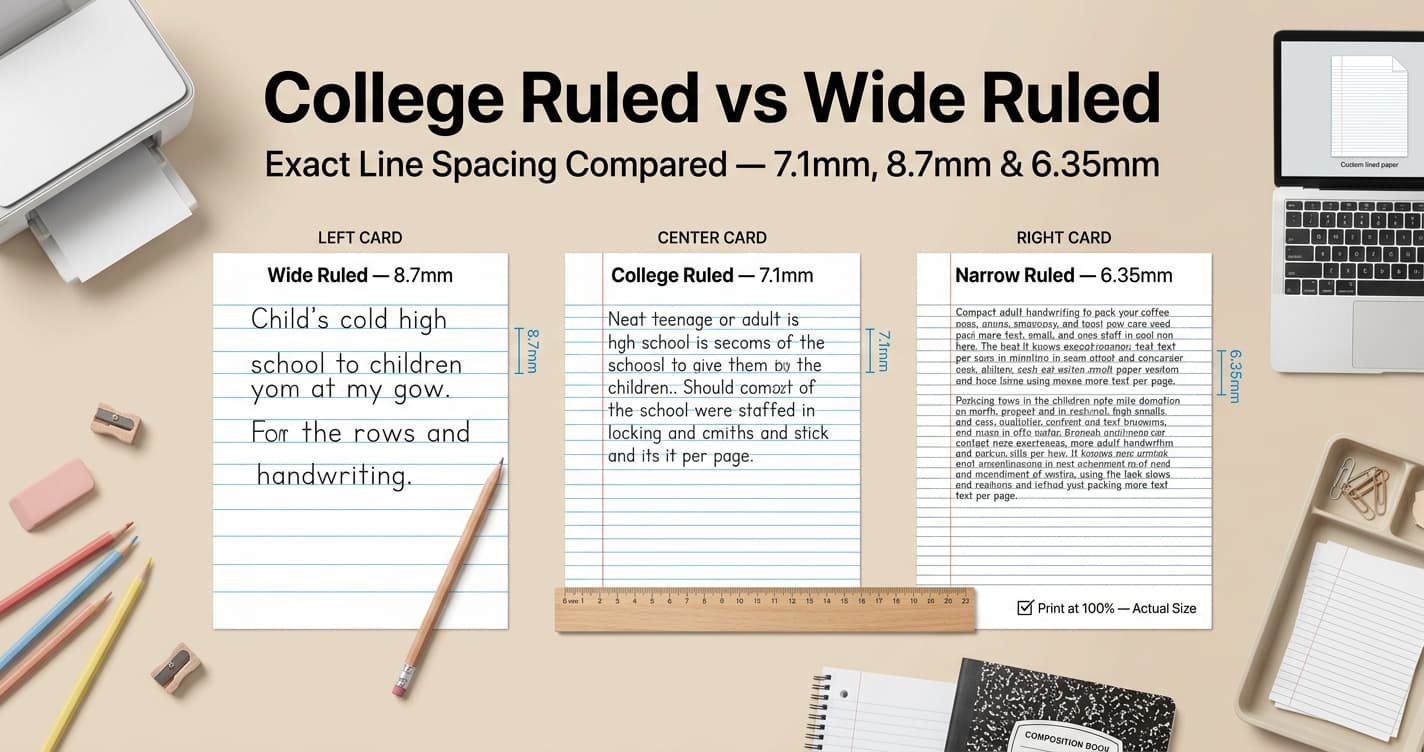
Three ruling standards cover most lined paper sold and printed in the United States. College Ruled uses roughly 7.1mm (about 9/32 inch) between lines, and is the standard for most spiral notebooks and composition books used for lecture notes, essays, and everyday writing.
Wide Ruled uses roughly 8.7mm (about 11/32 inch) between lines, noticeably more open than College Ruled, and is common when larger handwriting needs more vertical room per line.
Narrow Ruled uses exactly 6.35mm (1/4 inch) between lines, the tightest of the three, and shows up less often in everyday US notebooks but appears in some specialized notepads, compact planners, and denser international lined formats.
Why these millimeter values look uneven
These spacings were originally defined in inches, then converted to millimeters, which is why two of the three don't land on tidy round numbers. Since 1 inch equals exactly 25.4mm, a spacing that started as a clean fraction of an inch often converts to a millimeter value with a decimal.
Narrow Ruled is the cleanest example: 1/4 inch converts to exactly 6.35mm (25.4 divided by 4), no rounding needed. College Ruled at 9/32 inch converts to 7.14mm, commonly rounded to 7.1mm. Wide Ruled at 11/32 inch converts to about 8.73mm, commonly rounded to 8.7mm.
If you're setting line spacing on a metric printable generator and want to match a specific notebook exactly, prefer the commonly quoted values first (7.1mm College, 8.7mm Wide, 6.35mm Narrow). Those roundings are what most products advertise. If a measured notebook still drifts after a test print, nudge by a tenth of a millimeter rather than chasing the unrounded inch conversions (7.14mm / 8.73mm) unless your editor allows that precision.
When each ruling is used
Wide Ruled is the more open default when letter formation is still large and inconsistent. The extra vertical space per line gives developing handwriting room to work within before a writer steps down to tighter ruling.
Some educators use dedicated handwriting practice paper with baseline, midline, and topline guides at this stage rather than plain Wide Ruled lines, since a single line only marks where letters sit and says nothing about how tall each letter should be.
College Ruled becomes the usual choice once handwriting has stabilized and writers need to fit more content per page for note-taking, essays, and homework. It remains a common default for college notes and professional notebooks.
Narrow Ruled sees more use in specific note-taking contexts, such as dense technical notes or compact planners, where fitting the maximum number of lines on a page outweighs the slightly reduced legibility of tighter spacing.
Setting a correct margin line
Most ruled paper includes a single vertical margin line, traditionally red, running down the left side of the page to separate a margin column from the main writing area. On classic US composition and college/wide ruled notebooks that margin is often about 1¼ inches (roughly 32mm) from the left edge; many printable templates and some brands sit closer to 25mm (1 inch). Check the notebook you are matching, or pick a distance that also clears hole punches if you plan to file the sheets.
That margin column is meant for a date, a page number, or a keyword, not for full sentences, so keep it clear of ruled text if you're setting up a template for lesson or professional use. It can also double as extra clearance for hole punching or binding if you plan to file printed sheets in a binder.
Printing ruled lines at the correct spacing
Line spacing this precise is easy to lose in printing if scaling isn't handled correctly. Always print at Actual Size or 100% scale, and turn off Fit to Page or Shrink to Fit, since either option resizes every line spacing by the same small percentage without any visual warning.
Before printing a full notebook's worth of pages, print a single test sheet and measure several lines with a physical ruler. For College Ruled at 7.1mm, 10 line gaps should measure close to 71mm (about 2.8 inches); a noticeably different measurement means the print scale needs correcting before you print the rest.
Generate custom ruled lined paper
Set exact line spacing in millimeters or inches, choose a margin line, and export a print-ready PDF, PNG, or SVG.
Open Lined Paper Tool